

She Was Home
On grief, the body, and the friend who wasn't just a person but a place

It’s been six days. Six days ago, I lost one of my best friends of fifteen years — a mother of four boys, forty-one years old, after two years of fighting a cancer that never fights fair. Today is my grandmother’s birthday, the first one since she left us in March.
This piece is for Kris. I am writing it because I don’t know what else to do with my hands.

I can still hear the sound of her laugh and am feeling extra grateful for saved voicemails.
The other day while I was working in the kitchen, it felt almost like I was transported into her kitchen instead. I was cooking at her stove, looking up at the ‘just keep swimming’ sign she had hanging above it. When I was washing the dishes, I looked up into her back yard, I could see the little garden she had been growing, the wide-open field, hear the kids playing and running like little feral wolves around the house.
I never really told them when I was coming home. I’d just show up, and they’d all pull us in — fold us in, like we had never left at all.
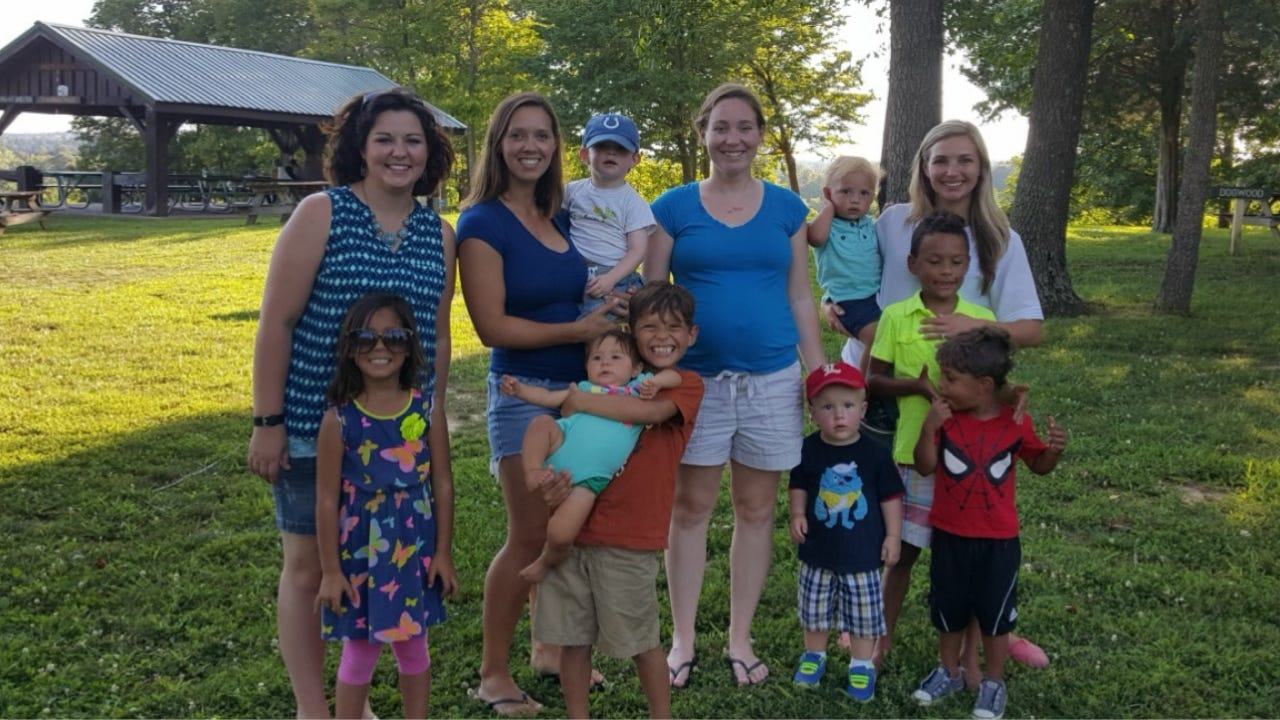
That was our routine for most of the last fifteen years. No performance, no catching up required really. I would walk in and the boys would barely look up, and she would already be talking to me mid-sentence, like the conversation had just been on pause. Some visits it was just us sitting at the kitchen table while all the kids went down into the basement to play. Some visits it was all of us, me, Kris, Becky, and Liz sitting around the table with hummus and veggies and anything else we pulled together. So much love, laughter, and the beautiful soft feeling of being accepted - fully.
People can sometimes talk about friends like they’re a category below family, but Kris was not a category. Kris wasn’t just a friend for me; she was a place. She was home for me the way Grandma was home, the way Mom and Aunt Bonnie are home — a person my nervous system recognized on sight and immediately stood down for. I didn’t have to arrive anywhere when I was with her. I was already there.
The body knows the difference between people and places, and it also knows when a person is a place. Researchers call our closest bonds “attachment figures” — the handful of humans whose presence measurably regulates our heart rate, our cortisol, our breath. When we lose one, the brain doesn’t just grieve a relationship. It grieves a location. A wayfinding point.
This is why grief so often feels like being lost — because, neurologically, you are.
I have spent six days square dancing with the so-called stages of grief.
That’s the only way I can describe it. Nobody tells you the stages aren’t “stages” at all — you don’t pass through anger, collect your stamp, and move on to bargaining. They circle. Swing your partner: denial, round and round. Now grab anger, round and round. Now depression. Now a strange flat hour of something like acceptance and then anger cuts back in and takes your hand again.
Even Elisabeth Kübler-Ross, who gave us the five stages, spent her later years trying to tell everyone she never meant them as a straight line. Grief is not a hallway. It’s a dance floor, and you don’t get to pick the caller.
And here is where the anger keeps landing: on me.
Because I wasn’t there.
Not the way I should have been.
I live far from home now… I’ve been off building a business, crossing the country, lost in my own world — and my friend was dying, and I kept thinking about reaching out instead of reaching out. I work with the nervous system. Breath, presence, the body’s capacity to hold what feels unholdable — this is literally my work. And when I was home, I would talk to her about it, tell her… “you need to do this! I’ll send you videos.”
But I didn’t. Most of the time, I felt… oddly scared to. I didn’t want to impose. I didn’t want to bother her. I stayed small and quiet and told myself the story we all tell: she’ll beat this. There’s time.
There wasn’t.
My dance partner today is anger it seems… but I’m also trying to be self-aware right now, self-aware but honest. I want to be honest about this regret without letting it lie to me.
The lie says I could have saved her. I couldn’t have — no one could, not her doctors, not her family, not any practice or protocol I could have carried home in my hands… The truth is smaller and it hurts differently: I could have called. I could have sat with her, even through a screen.
I could have been one more warm point in her sky those two years, and I let my own smallness talk me out of it.
That’s the regret I get to keep.
I’m learning that grief hands you your unlived actions and makes you hold them.
The only thing to do with them is let them change how you live now.
Grief has an address in the body.
Heartbreak — the longing kind, the lost-lover kind — lives low, a cavernous emptiness in the gut, like a hole bored straight through your midsection.
But this, this loss, sits higher: an anvil on the breastbone, heavy and crushing, hard to breathe around. The body wants to curl in, hunch, fold around the wound.
Science maps this too — grief activates the same neural regions as physical pain, and the vagus nerve, which runs right beneath the sternum, registers loss as a literal weight on the chest. The traditions I’ve studied put it more simply: heartache lives below the heart; grief lives on top of it.
Either way, the body is not being dramatic. It is being precise.
When Kris was first diagnosed, I went home to see her. She told me she was going to wrap a warm blanket of protection around her shoulders. That was her — even staring down the worst news a mother of four can receive, her instinct was to make something soft, something safe, something she could pull around herself.
Near the end, she told me she had tried to keep that blanket on. Tried — and then the pain took over her body, and she forgot. She called the pain evil, the cancer EVIL. I will not pretend that word away or wrap it in anything gentler. Some things should be named exactly what they are.
But the blanket is what I’m keeping.
Because of her, I know sweetness. I know gentle, consistent and steadfast friendship that shows up when you need it most. Like on your long drives to and from school. Like when you’re struggling with how to raise your kids right. Like when you just need someone to hear you without judging your wild internal dialogue — you’re just seen — as is and accepted that way with love so soft that you can truly deeply exhale.
Because of her, I know that home is not a house. It’s a nervous system that recognizes yours.
Because of her, I am done playing small. Done thinking about reaching out instead of reaching out. Done saving my particular medicine for some later that isn’t promised.
If her death teaches me only one thing, let it be this: the call you keep meaning to make — make it. Today. The people you love are not going to feel imposed upon. They are going to feel loved.
This is what grief asks of us in the end — not that we get over the person, but that we take over for them. Grief researchers call it “continuing bonds”: the healthiest mourners aren’t the ones who let go, but the ones who find a way to carry the person forward.
The love doesn’t need the body it came from. It needs new hands.
So today, on Grandma’s birthday, holding two griefs stacked one on top of the other, I am picking up the blanket.
I will wrap it around Q and those four boys — not this week, when the casseroles are still coming, but in the long quiet months after, when the world moves on and the house goes still. I will wrap it around my kids, around Becky and Liz, around everyone I’ve been meaning to call.
She was home. And the only way I know to survive losing home is to become it.
Join me in The Caim Circle membership for a space to be held — a space to be seen, heard, and loved, especially in the seasons that ask the most of us.
Find all my links, HERE, or book a discovery call with me, HERE.
See you next week. xx
Jessa
Thank you so much Meg. ❤️❤️❤️
I shed so many tears reading this. Thank you for cultivating the courage to feel grief so deeply. It inspires me to have the strength to carry my own. I read a quote recently that grief is the last evidence of love. You are so loved, so is she, and now, she is free 💛